Monday, April 3, 2017

Hadrian's Villa--by Nick

Text by Nick, photos by Kelli

Our group at Hadrian's Villa

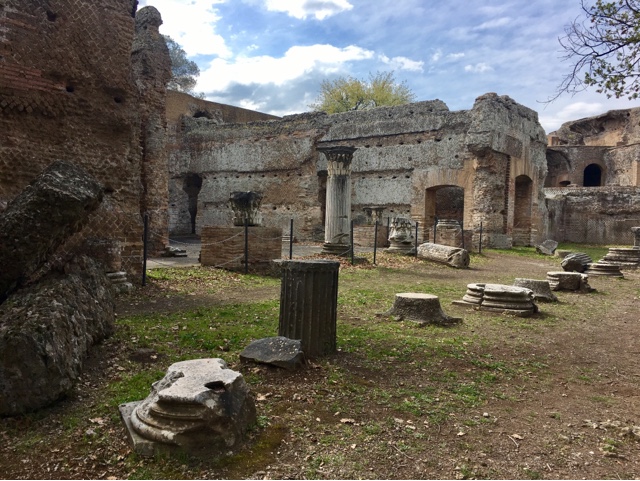
Today we explored Emperor Hadrian's countryside villa and the mythic cave of the sybil. Hadrian's villa was built in the first century AD and was used as a rustic retreat from busy urban life for Hadrian. The site features remarkably well-preserved statues and fantastic examples of ionic columns. Hadrian even had a statue of an alligator guarding one of his pools.

Pool at Hadrian's Villa


Even today, the piscinae (fish pools) that Hadrian built 2000 years ago still have cod swimming in them. The villa also was decorated with beautifully intricate mosaics, emblematic of the power and opulence of the Roman empire in the early first century CE.

Mosaic tiles in Hadrian's Villa

The villa encompasses a massive area, and should probably called a small town constructed for one family. After wandering the ruins for almost two hours, we had merely scratched the surface of the insights this site has into ancient life and into the mind of one of Rome's most successful emperors.


After the Villa, we traveled by bus to Cumae in the Naples region where we entered the cave of the Sybil, a prophetic fortune teller made famous by Virgil's Aeneid. The cave is said to be where the Sybil led Aeneas into the underworld to receive his destiny. In reality, the carved caverns simply lead to a small chamber, but perhaps the entry to the underworld was sealed off with the fall of the Romans.

Nick in front of  the Cave of the Sybil in Cumae

Inside the Cave of the Sybil in Cumae


Sunday, April 2, 2017

The Etruscan Necropolis of Cerveteri--by Grace


After our breakfast at Casa La Salle, we braved the rain and headed to the bus stop to travel to Cerveteri. We walked toward our usual subway stop, Cornelia, and left on the subway toward the bus stop to find that we were actually supposed to be back at Cornelia! After finally getting on the elusive bus, we "rested our eyes," as Kelli would say, and we were on our way! Cerveteri is a small, hilltop town about 28 miles outside of Rome. It contains Etruscan ruins that predate Roman times and also acts as an incredible viewpoint. 

Once there, our group found a wonderful lunch of paninis and gelato in the small piazza in Cerveteri. It turns out, food is a lot less expensive outside of Rome!! After our lunch, we headed toward the museum of Etruscan artifacts. 

We saw many artifacts found in the Etruscan necropolis that is also in Cerveteri. A necropolis is where the dead are buried in miniature towns, which they will live in their afterlife. 


The tombs are also filled with everyday items that the dead would need in their afterlife. These artifacts ranged from jewelry to gas lamps and from pots to perfume bottles. All had intricate details, often colored with red and black, and many depicted Dionysus, the god of wine, which reflects the importance of wine in Etruscan culture.

After seeing the museum, our group walked to the necropolis, not expecting what was to come! The walk down from the town of Cerveteri proved to be the most picturesque view of the Italian countryside. 

It was luscious, green, and very rejuvenating! As we continued on our lovely walk, we all saw sheep, a group favorite. 

When we finally descended into the necropolis, it was unlike anything I had seen before. The tombs were unfenced and we explored at our leisure. The tombs often had two rooms with stairs descending into them. They were built into the hillside into rock. Often families would be buried together and in many tombs we were able to see the place where the dead were laid. Some tombs were particularly dark and creepy, making it quite easy to scare each other! 


After the first, unfenced part of the necropolis we continued into the contained part of the tombs. We were able to see other types of tombs, although they did begin to blend together after a while! The best part was able to explore where we liked and we even took some naps in the tombs- not really, but we were able to lay down! 


After exploring, we headed back to catch the bus to Rome. We walked back along the road into Cerveteri and had one last gelato break before reboarding the bus. 

Walking back to town (Photo: KVVP)
After a short week in Italy, I think we have all figured out that gelato breaks are a major key! We bade goodbye to the countryside and happily yet drowsily entered Rome once again. 

I now sit here writing the blog, while we all pack and rest before going out to get a carry out dinner, the same dinner on our first night of Rome! I think I can speak for all of us when I say that we are feeling nostalgic about leaving Rome but also incredibly excited for our adventures to come! 
Ciao Roma! 


The Via Appia by Steven

To start the day I woke up, had the typical breakfast, then set out with the group to see the mouth of truth (which is really just a manhole cover that has been shaped into a face with an open mouth). It is said if you stick your hand in its mouth and you are a liar it will bite your hand off. I apparently was not a liar. Afterward we got snacks and went into the baths of Caracalla, which was the second biggest roman bathhouse in Rome. One thing I have learned on this trip is that any roman building that was useful to the Christian church iethe baths of Diocletian, or the Parthenon, aged pretty well. Anything else was stripped for parts and used to make a new church. The baths of Caracalla, although they were probably big enough for 4-5 churches, were apparently not very useful to the church and were not well cared for as a result, but some mosaics were still left and the size of the outer walls was truly humbling.
After checking those out, we headed to THE VIA APPIA. 


When our Latin class (Austin, Steven, Michael, Andrea, Emily, John, and Grace) was still in the early days of learning Latin we read through a textbook series called “Ecce Romani” (Look Romans). In part of the series (which I have become a raging fan of) our favorite characters Sextus molestus, Gaius, Aurelia and Cornelia’s carriage had been run off the Appian way by a light two wheeled carriage. We translated their adventures of attempting to get out of the ditch for (at least what felt like) a solid 3 months. Ever since then the cringe worthy, kindergarten level phrase “raeda in fossa est,” (The carriage is in the ditch) has been somewhat of a class meme. Therefore, I was very excited to see the “real spot!” on the Via Appia where the raedareally was in fossa est, despite the fact that Ecce was a fictional book. 
In the ditch!


Strolling down the Via Appia
That’s why I was really disappointed when our Via Appia journey, which by the way had taken almost 2 miles longer than anticipated, was interrupted by a tour of the catacombs of St. Sebastian. However I was quickly appeased.

San Sebastiano
The catacombs were awesome, and I can see why so many textbooks, movies and videogames (Skyrim in particular) would take inspiration from them. Any feeble attempt by me to describe them wouldn’t do them justice, so here are some pictures (which we did not take ourselves by the way… that would be disrespectful). 


Just for kicks, here is a picture from the videogame Skyrim which was inspired by the Roman empire and catacombs. You can see the eerie similarity in the layout of the tombs.


Each corpse would be wrapped in a linen, then their grave would be sealed off by quicklime and a marble headstone. According to our tour guide 60,000 + people have been buried there and it is one of the 20 catacombs of ancient Rome lining the roads on the outskirts of the city. No dead were allowed to be buried inside the city.
After seeing St. Sebastian’s tomb, the catacombs, and the church on top, we resume our Appian journey. I found several modern “raeda”s parked in what is left on the fossa on the side. Not that the road is in bad shape, the original stones are there with the marks of passing carriage wheels still readily visible in them, but the ditch isn’t as grand as the one in Ecce. Nonetheless, our class found the fossa-iest fossa we could find and posed for a long awaited picture. Although, having walked several miles along the paved portion of the Via Appia just to get there, the rest of the group –NOT ME- but the rest of the group decided it was time to take a bus back to the metro and travel to the Spanish steps for freetime.
The free time was also great today. Due to our late lunch on the Via Appia, dinner and our free time was combined in a certain area of the city. I got gelato, and 1 kilo of pasta for 10 euro before meeting up with another group to have dinner. We sat down at the first restaurant with room for 7, which was easy to find because every restaurant on the street has a person outside trying to coax people into the doors. After dinner we went shopping and I don’t do a lot of shopping, but I think I walked into some of the nicest stores I think I’ve ever been to in my life. They were all extremely upscale, with awesome, custom tailored interior design and had some ridiculous pricetags to go with it. For me it was all window shopping, but at some of the more reasonable places others were feeling bold and decided to buy an Italian clothes. We then headed back to Casa la Salle and I was finally able to sleep.
On the Spanish Steps ready to head to the Metro back to Casa la Salle


Saturday, April 1, 2017

There's gelato in my gelato!

After many hours of walking this afternoon, we stopped for snacks on the Via Appia.  The students were very impressed with this particular stand that gave them a little something extra with their gelato order!


Another Great Day in Rome Including the Circus Maximus and the Baths of Caracalla--by Devika

Text by Devika, Photos by Kelli unless otherwise noted

Today was our final day in Rome since tomorrow we will go outside of the city to Cerveteri before leaving for the south on Monday. With sore feet and sun burned faces, we made our way to our usual subway stop: Cornelia. After a busy subway ride with a transfer to end at the Forum, we walked next to the Tiber River and to the Santa Maria in Cosmedine. If one has watched Roman Holiday, you'd recognize the statue where the characters place their hands in the mouth of a statue. Word has it, the statue there can tell if you are a liar or not. You place your hand in the daunting smile of the statue, if you are truly a liar, your hand will be cut off. As haughty teenagers, we assumed we'd all be left handless! We've all lied about finishing our homework at some point! Sadly, we all still have our hands attached. 


La Bocca della Verità


Some students explored the inside of the church while some had to wait outside. The church was extremely small but well worth it. 


After our adventure at the church, we made our way to the circus Maximus. For those who have not had a classics class, the circus Maximus is where all the racing events happened. There were four teams to pick from and your usual Roman would have their favorite team. Just like our modern day football spirit, ancient Romans had their share of games. Fun Fact: the Ars Amoris (a book on how to find love) suggested that one sides with the same team as their crush in a way to advance in a relationship! Because we were at the racing grounds, we just had to race each other like the ancients. We first started out with a small speed walking race, every man for themselves! And in the end , Telly placed first. Then, a few kids ran down the Spina ( the long island where chariots would race around). Telly once again came in first, but everyone did their best. We were quite the spectacular sight for all the tour groups exploring the grounds. And gave our peers a good sigh to laugh at. 


A speed walking race around the Circus Maximus
Sweaty from our adventures, we moved to the Baths of Caracalla.
Walking around the Circus Maximus and towards the Baths of Caracalla.

The Baths were built between 212-217 A.D. The grounds for the baths are around 20 feet larger than Overlake, and we had an amazing time exploring them. With two gym areas and an extremely large bath space, there was much to see. We saw amazing mosaics and beautiful arches! It was truly interesting to finally see a bath house after studying them for many years. Personally my favorite was the large pool! It was about that size of the pools used at the Olympics. One would think that an area with two large gyms, an Olympic sized pool, and a large bath area would only be for the elite. Yet, the Baths are free for all to use. The Romans used their houses for sleeping, eating, and maybe an occasional party , while we use our houses for work, play, and everything else. The baths were used to meet new people, bathe, and even take part in some games. Pool games aren't a modern invention at all, It's said that the Romans might have played a game with a small ball by the edge of the pool: the foundation for water polo. The baths were a hit among everyone, and we were all extremely sad to leave the ancient place. Yet, with stomachs empty and our eyes dancing with excitement for the Via Appia, it was time to leave.


The Baths of Caracalla

The Baths of Caracalla

The Baths of Caracalla

The Baths of Caracalla

The Baths of Caracalla and Telly

Pieces of the ancient mosaic floor


Check out Steven's upcoming post for the afternoon adventures including the Catacombs of San Sebastiano and the Via Appia.

Our last night was truly a night to remember and we all have different stories to tell. We split up into small groups and had three hours to eat and explore. My group spent some time shopping and even got some gelato with a shot of espresso on top called affogato. Truly delicious! I spent the night walking around the Spanish Steps and enjoyed learning more about my peers on the trip. After meeting back up, we moved towards the Spagna metro station to climb aboard our usual subway train back to the Casa la Salle. We were all exhausted and stuffed, ready to hit the hay and rest for another day in Italy.